
Published: August 2024
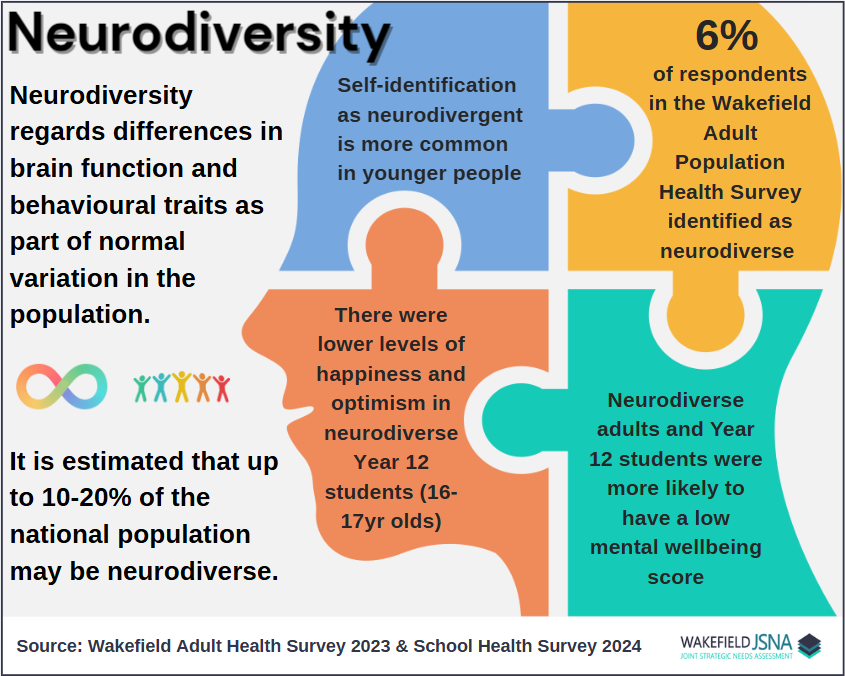
Neurodiversity regards differences in brain function and behavioural traits as part of normal variation in the population. Uncovering the strengths of neurodiverse people and utilising their talents can help increase innovation and productivity of society as a whole. Neurodiversity can include autism, ADHD, dyslexia, dyspraxia, dyscalculia and Tourette’s, as well as neurodevelopmental conditions.
The results presented here are being regarded as experimental statistics as this is the first time self-identified neurodiversity data has been collected in local surveys in Wakefield. Further development of the approach may be required.
Headlines
- Depending on the definition used, it is estimated that up to 10-20% of the national population may be neurodiverse. Some people need little or no support, whereas others may need more help. It is likely that neurodiversity is under diagnosed and self-identification is becoming more common as neurodiversity awareness increases.
- 6.4% of respondents to the 2023 Wakefield Adult Population Health Survey and 30.1% of respondents to the 2024 Wakefield School Health Survey reported to be neurodiverse.
- The neurodiverse population is generally younger than the neurotypical population. This may be due to a number of factors, including more established referral pathways for children and young people, and younger people potentially being more likely to self-identify as neurodiverse.
- Neurodiverse adults and Year 12 students were more likely to have a low mental wellbeing score and less likely to feel safe in the area they live than their neurotypical peers. Neurodiverse adults were almost three times as likely to report that their general health was ‘Bad’.
- There were lower levels of happiness and optimism about the future in neurodiverse Year 12 students.
Neurodiversity and increasing awareness
There is a wider trend of rising awareness, acceptance and also celebration of neurodiversity in society, both nationally and locally.
It is becoming more clear that people show traits associated with neurodiversity to varying extents across the population and it is not just people with a diagnosis whose experience is influenced by these traits. People’s experiences of neurodiversity are highly variable and it is common to have traits related to multiple neurological differences.
It is likely that neurodiversity is under diagnosed. For example, less than a quarter of a percent of the Wakefield adult population have an autism diagnosis on GP systems. However, according to national NHS Autism Statistics, the number of monthly referrals for suspected autism has more than doubled since 2019 (see the Further Information section below). Self-identification as neurodivergent is becoming more common.
Men and boys are currently more likely to have received a diagnosis than women and girls. Historically, neurodiversity has been under diagnosed in women and girls because of differences in how it can present in females and potentially mis-conceptions around autism affecting males only. Some neurodiverse people may also be living with a learning disability (see the Further Information section below for other related resources).
Respondents to the 2023 Wakefield Adult Population Health Survey and 2024 Wakefield School Health Survey, the data sources for the analysis presented below, were asked if they considered themselves to be neurodiverse.
What are the differences within Wakefield district?
In the 2023 Wakefield Adult Population Health Survey, people were asked about whether they considered themselves to be autistic, dyslexic, dyspraxic or have ADHD. It was found that 6.4% of respondents identified as neurodiverse. The interactive dashboard below can be used to explore the demographics and inequalities of adults who reported that they were neurodivergent. Click on the buttons at the bottom to navigate between the different measures. Use the buttons and filters sections at the top of each page to explore the different demographics and survey questions. The neighbourhood breakdown in the dashboard are the Wakefield Council Public Health Intelligence (PHI) defined neighbourhoods.
Adults
In the 2024 School Health Survey, Year 12 students were asked, for the first time, about whether they considered themselves to be neurodiverse. This included autism, ADHD, dyslexia, dyscalculia, dyspraxia and an ‘other’ category. Self-identification as neurodivergent is becoming more common and almost a third of Year 12 students identified as neurodiverse in the survey (30.1%), compared to national estimations of around 10-20%. Children and young people’s referral pathways are more established than adults in this area, however younger people may also be more likely to identify as neurodiverse, or identify with some characteristics of neurodiversity, due to an increase in neurodiversity awareness, more exposure on social media, and greater neurodiverse representation online, in media and in TV/film. The interactive dashboard below can be used to explore the inequalities of Year 12 students who reported that they were neurodivergent, compared to their neurotypical peers. Use the filters section at the top to explore the different survey categories and questions.
Year 12 students (16-17 year olds)
Further information
- The Brain Charity – Neurodivergent, neurodiversity and neurotypical: a guide to the terms
- Autism Waiting Time Statistics – NHS England
- Attention Deficit Hyperactivity Disorder (ADHD) Taskforce – NHS England
- Wakefield JSNA – Special Educational Needs
- National Autistic Society – Varying support needs
- NHS England – Learning Disability and Autism
- NHS England – Learning Disability Services Statistics (Learning Disabilities and Autism)
What support is available?
- West Yorkshire Health and Care Partnership – Neurodiversity
- South West Yorkshire Health Partnership NHS Foundation Trust – Adult autism service and assessment
- South West Yorkshire Health Partnership NHS Foundation Trust – ADHD autism service and assessment
- West Yorkshire Healthier Together – Neurodiversity
- Society For Neurodiversity (s4nd.org)