
Published: May 2026
A learning disability is a long‑term cognitive impairment that affects the way a person understands information, learns new skills, and manages everyday tasks. It varies from person to person and does not define an individual or their abilities. A learning disability is often identified soon after birth or in the early years, and will last a person’s whole life.
Many people with a learning disability may find everyday activities challenging – for example household tasks, socialising, or managing money. Some people with a learning disability need to be fully supported in all areas of their life, including communicating, personal care, and staying safe. People with a learning disability may take longer to learn and need support to develop new skills, understand information, or interact with other people. They may also have a learning difficulty or be neurodivergent.
Although a learning disability is permanent, many people can develop new skills throughout their lives. And, societies and communities can change to be more inclusive. With the right support and an inclusive community, people with a learning disability can thrive.
Headlines
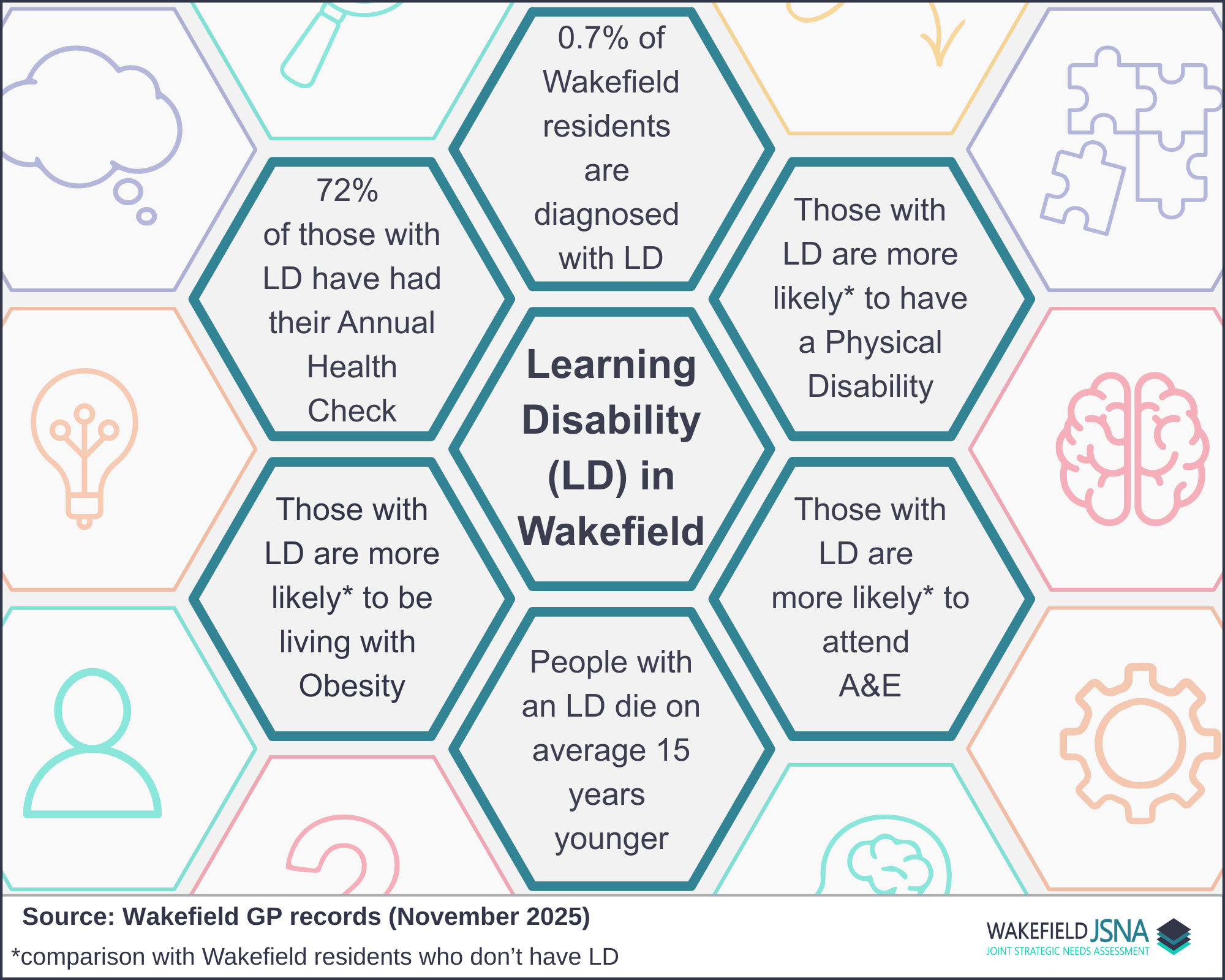
- 0.7% of the Wakefield population (around 2,400 people) are recorded on GP practice systems as living with a learning disability, however it is possible that it is under-recorded in GP systems. This is significantly higher than the 0.6% for England.
- Looking at death data between March 2025 and February 2026, people recorded with a learning disability died on average 15 years younger than those who were not recorded with a learning disability.
- People recorded with a learning disability are almost twice as likely to access primary care, twice as likely to attend A&E, 3 times more likely to be admitted to hospital as an emergency, 5 times more likely to call 111, and nearly 8 times more likely to attend Mental Health services than those without a learning disability.
- An estimated 2.34% of the Wakefield District population are living with a learning disability based on the PANSI and POPPI projections. The percentage of people with a learning disability in Wakefield is not projected to change in the coming years. Wakefield is similar to other areas looking at projections for the year 2035.
Projections and Prevalence in Wakefield
Learning disability projections presented on this page are taken from the the Projecting Adult Needs and Service Information System (PANSI) and the Projecting Older People Population Information (POPPI), which provide insights into the health needs of the adult population aged 18+, including those with learning disabilities. The PANSI/POPPI definition includes learning disability, Down’s syndrome, and those who are autistic. Further information on the PANSI/POPPI data can be found here: Projecting Adult Needs and Service Information System / Projecting Older People Population Information System.
Learning disability prevalence presented on this page uses data recorded in Wakefield GP practice systems. It only includes where a learning disability diagnosis has been recorded and does not include neurodiversity. It is possible that learning disability is under-recorded in GP systems – people with mild learning disabilities may never be diagnosed and historical under diagnosis may play a part in this.
See the notes section of each dashboard for more information on inclusions and definitions.
The JSNA Neurodiversity page includes information on adult and Year 12 pupil (16-17 year old) self-identified neurodiversity.
How does Wakefield compare and what are the differences within the district?
Based on learning disability recorded in Wakefield GP practice systems… The interactive dashboard below can be used to explore the demographics and inequalities of people with learning disability recorded on GP practice systems. Click on the buttons at the bottom to navigate between the different pages. Use the buttons at the top of each page to explore the different demographics and inequalities. Click the ‘Notes’ button to find out more about inclusions and definitions.
Learning Disability Prevalence
Based on learning disability projections in the PANSI and POPPI data… The interactive dashboard below can be used to explore the learning disability population projections in Wakefield and other local authorities in the coming years. Click on the buttons at the bottom to navigate between the different pages. Click the ‘Notes’ button to find out more about inclusions and definitions.
Learning Disability Projections (including LD, Down's syndrome, and Autistic)
Further information
- Support for Learning Disabilities | Learning Disabilities Care Pathway | Wakefield Connect to Support
- Learning disabilities | Wakefield Council
- Learning Disability | Mencap
- Sense | For disabled people
- Shared Lives | Wakefield Council
- Learning Disability | Dimensions
- Wakefield & District Down’s Syndrome Support Group
- Projecting Adult Needs and Service Information System
- Projecting Older People Population Information System
What support is available?
- Safe Places for people with learning disabilities and autism – Wakefield Council
- Blind or disabled person’s travel pass – Wakefield Council
- Day opportunities service – Wakefield Council
- Disabled facilities grant process – Wakefield Council
- Find a support group | Mencap
- Learning Disability Support Services | Mencap
- Learning Disabilities Care Pathway | Wakefield Connect to Support