
Published: February 2026
Tackling Climate Change Together is one of the ambitions of Wakefield’s District Plan. This section of the Joint Strategic Needs Assessment gives an overview of how the climate is changing and a summary of the consequences for health arising from this. It also provides some information the health benefits that can come from action on climate change, such as moving to low carbon, clean energy. It provides links to other key sources of information. Over time this section will be developed to cover more local in-depth content.
The climate is the long-term weather conditions and temperatures of an area. In recent times there have been changes in UK climate including in Wakefield, this has included: higher average and Summer temperatures, higher than average rainfall, an increase in temperature extremes and more frequent and intense storms. These changes will have an impact on health both directly and indirectly across the District now and into the future. There will still be periods of colder weather which can also be harmful to health.
The UK’s 3rd Climate Change risk assessment report by the Climate Change Committee [1] sets out the direct, and indirect ways in which climate change can negatively affect our health in the UK, many of which are relevant to Wakefield. A warming climate affects health in 3 main ways:
- Effects of extreme weather, such as heatwaves, flooding, wildfires, storms and drought on physical and mental health (for example injuries and trauma, heat-related illness, infectious disease linked to flooding and poor air quality linked to fires and storms).
- Effects on the planet’s life-support systems, such as rising sea levels and safe water availability, changing patterns of zoonotic and vector-borne disease (for example malaria, dengue fever), reduced pollination and crop failure leading to food shortages.
- Effects mediated by social systems, such as livelihood loss, rising prices of food and fuel, supply chain disruption, pressure on health and care services, conflict or forced migration.
Headlines
- Weather conditions including hot and cold temperatures, snow and ice, storms and flooding can have an impact on the health of people living in Wakefield District.
- Globally and nationally, including in Wakefield, there has been a trend of increasing average temperatures over recent years leading to a changing climate.
- Wakefield Council declared a climate emergency in 2019 and has chosen tackling climate change together as an ambition in the 2025-2035 Wakefield District Plan.
- The health of people in some groups of the Wakefield population will be more affected by climate change due to where they live, their age and their underlying health.
- Through national and local action in Wakefield we can reduce the negative health impacts of climate change through reducing greenhouse gas emissions (mitigation) and responding to changes that occur (adaptation).
- Climate change can impact both physical and mental health, some of the actions that help us respond to the changing climate also benefit health in other ways.
- Progress is already being made with total CO2 emissions for the District reducing by 27% since 2014
Climate and Health Overview
There is international, national and local evidence of the health impacts we might see in Wakefield due to climate change. For an national overview see the UK Health Security Agency report on the Health Effects of Climate Change (HECC) [2]. The different factors that come together to influence how climate affects health are: exposure, vulnerability and hazard. Different people or areas of the District may have different risks of higher exposure for different climate and weather types. For example, those who work in manual occupations outside for heat effects or who live near a river for flooding. Age or pre-existing medical conditions will affect vulnerability in Wakefield. Hazards will vary and have different risks to health depending on the type of climate or extreme weather. Over the last two decades we know the average annual temperature across the world has been increasing, this is also seen in Wakefield [3]. The Met Office UK Climate Projections 2018 (UKCP18) can be used to model future climate changes for Wakefield and are available through their Local Authority Climate Explorer [4]. The explorer produces a report giving an introduction to how climate change forecasts are developed. It also gives an in-depth picture of temperature changes in Wakefield. There are a number of other mapping, climate indicator and visualisation tools available including the UK Climate Risk Indicator Explorer [5] and Show Your Stripes which visualises average temperatures over time [6]. Independent guidance, adopted by the UK government for the Climate Change Risk Assessment (CCRA) and 3rd National Adaptation Plan (NAP3) [1], is to prepare for a 2°C rise in global temperature, whilst assessing the risks for 4°C. The table below gives the UKCP18 estimates for Wakefield for selected climate changes of different magnitudes. The timing of when a specific level of global warming is reached depends on future global emissions combined with other environmental factors. For example, 4°C of warming could happen by the end of the century under a high impact scenario, but this is unlikely. The further into the future we look, the more uncertain predictions become. For Wakefield the following changes are predicted under a 2°C rise in global temperature [4]: Looking at a more extreme rise of 4°C the changes in Wakefield’s climate would be greater. See the table below with values taken from the Met Office local authority climate explorer for Wakefield District for more information [4]:How can we know how climate can impact health?

There are different actions that can be taken to prevent (mitigation) and reduce (adaptation) some of the effects of climate on health. Many will have co-benefits for health in the Wakefield District. The graphic below gives some examples of climate, weather effects, and themes that are relevant. A web section is currently available on heat and health: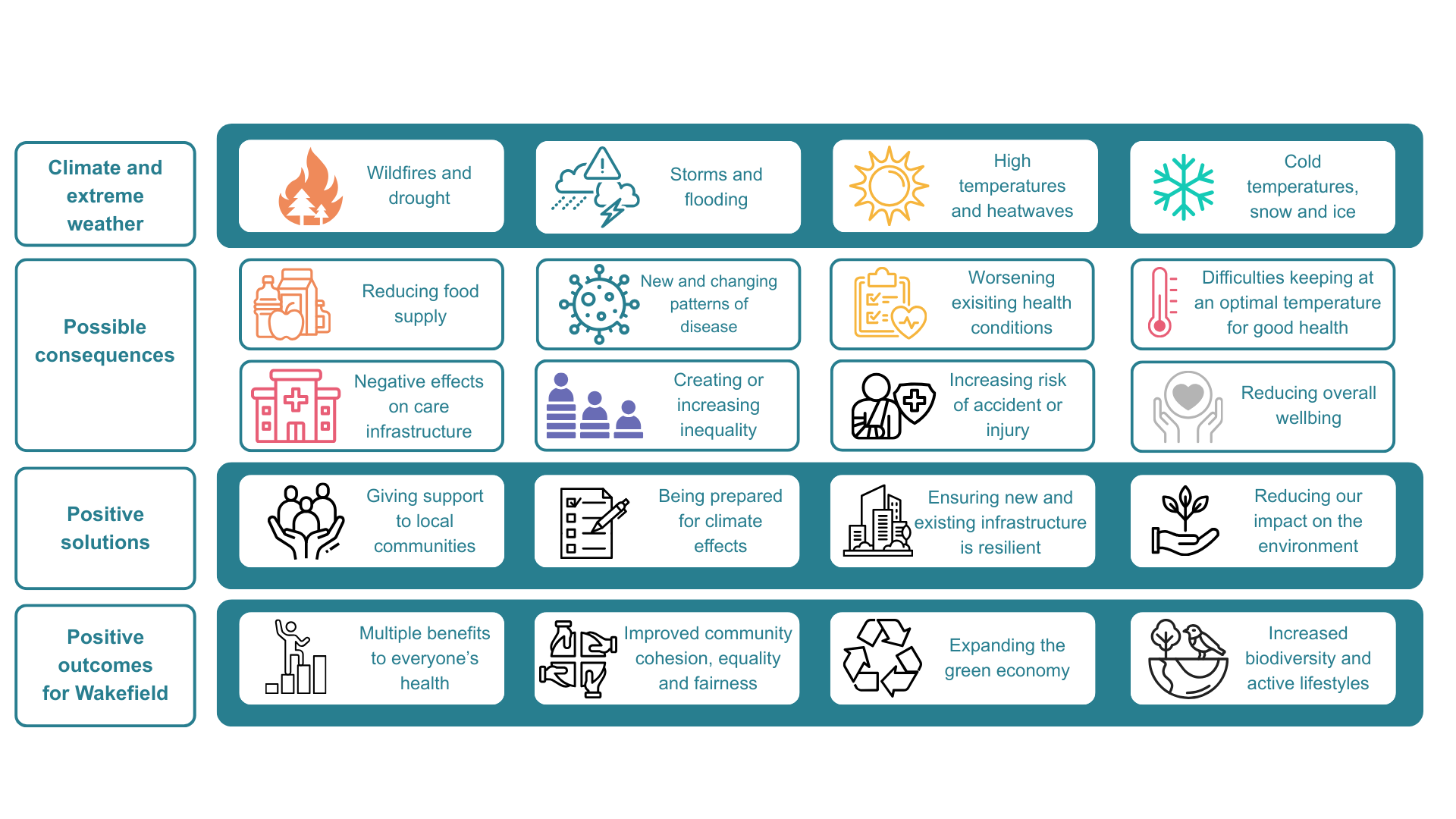
How has climate changed up to now and what is the future?

Increases in greenhouse gas emissions in the atmosphere are a leading cause of climate change. The main greenhouse gas is carbon dioxide. Carbon dioxide is mainly produced through the burning of fossil fuels at power stations for producing power for businesses and homes. Another major source is powering vehicles such as cars, trucks and aeroplanes. Other greenhouse gases are produced in other ways including deforestation, agriculture and landfill sites [7]. Greenhouse gases trap heat from the sun in the atmosphere. As production has increased over the last century it has caused a pattern of climate change across the world, leading to higher temperatures and more extreme weather events such as flooding. There are two main ways to think of the changes that are needed [8], different changes may be at international, national or local levels: These changes need to be made fairly and equitably across the District to reduce inequalities and to protect groups who are more sensitive to the effects of climate change. Wakefield Council declared a climate emergency on the 23rd of May 2019. Work has taken place across Wakefield including the creation of an action plan for how we can reduce greenhouse gas emissions as a population and local authority. Some ways to reduce emissions in Wakefield suggested in the plan include: More information can be found on the Wakefield Council climate change page [9]. The Council’s commitment to tackling climate change is reflected in the 2025-2035 Wakefield District plan with an ambition to tackle climate change together. The aim from the plan is: “That by by 2035, we will reduce the district’s carbon footprint on the journey to net zero, improve public health and help our residents and businesses adapt to a changing climate. We will ensure that the impacts of climate change are addressed in a fair, just and inclusive manner.” [10] The four outcomes related to the ambition are: Further information on climate statistics for Wakefield can also be found in Chapter 9 of the 2024 State of the District report [11]. Adaptations will vary depending on the type of climate effects but can include, for example: As well as helping to reduce the effects of climate change, many mitigation and adaptation actions will also create a healthier living environment for everyone in Wakefield. These benefits include:
The dashboard below gives some information for Wakefield including greenhouse gas emissions, fuel poverty, electric vehicles, air pollution mortality and recycling. It also presents small area carbon footprint estimates using data from Carbon and Place, an initiative lead by the University of Leeds [12]. Key findings from the dashboard show:
There is public support for climate action, this has been seen internationally with large scale studies finding that across the world people in different countries are supportive. A large international survey found 86% of the global population endorsed pro-climate social norms, in the United Kingdom where 86% endorsed pro-climate norms [13].
Why is the climate in Wakefield changing and what action is being taken?
In addition to reducing carbon emissions, increasing biodiversity and expanding green spaces, such as nature reserves and parks, can help absorb some of the greenhouse gases produced. Across Wakefield, new green spaces are being developed, and a district-wide tree‑planting programme is currently underway [9].
Climate Summary Dashboard
Public opinions on climate change action and the views of people in Wakefield
Locally, people in Wakefield have also shown interest in climate issues. Events including a Citizen Visioning workshop and the annual Global Climate Change Summit brought together people from across Wakefield to discuss issues locally and health was a key theme raised at both events.
In the 2024 School Health Survey 15% of pupils worried about climate change a lot or quite a lot [14]. Year 12 students aged 16-17 years old were also asked more in-depth questions about climate change, 58% agreed it was a very serious problem and 41% were worried about its effects. An international study of climate anxiety in children and young people found 49% of 16-25 years olds surveyed in the UK were extremely or very worried about climate change [15].
A 2023 national survey found that 82% of people expected the UK to be affected by health risks from heat waves and other unpredictable weather and 76% are worried about how those health risks will affect them personally [16].
Climate change can impact mental health directly through people experiencing traumatic events such as flooding and other natural disasters [17]. People can feel anxiety due to the wider environmental harm affecting the planet as a whole [18]. The Mental Health Foundation has raised that though climate anxiety can have a negative effect, action and efforts to mitigate climate change have a positive impact on wellbeing and mental health [19].
References
Further Resources
Wakefield Council Climate webpage The Wakefield Council Climate page gives information on the Council’s climate action plan and wider resources and news about climate related initiatives in Wakefield. Learn about the Wakefield District’s 2030 carbon neutral pledge, other climate change initiatives, and how you sign up to their monthly newsletter. Link: https://www.wakefield.gov.uk/environment-and-climate-change/climate-change/ Wakefield Together District Plan 2025-2035 The recently launched District plan sets out a vision of building a stronger Wakefield. This is based on six ambitions, one of which is tackling climate change together. Link: https://www.wakefield.gov.uk/media/ld5pzcn5/wakefield-district-plan-2025-2035.pdf Yorkshire and Humber Climate commission The Yorkshire and Humber Climate Commission is an independent advisory body that brings together a wide range of people from the public, private and third sectors to support, facilitate and enable the delivery of ambitious climate action across Yorkshire and the Humber. Their four aims are: Their climate action plan was published in 2024. Link: https://yorksandhumberclimate.org.uk/ UK Government Climate Change Risk Assessment The UK Government is required, under the 2008 Climate Change Act, to publish a Climate Change Risk Assessment (CCRA) every five years which is published on the Government website. The assessment sets out the risks and opportunities facing the UK from climate change. The UK Government’s most recent assessment, the third CCRA (known as CCRA3) can be found at this link and includes several areas relating to health. Link: https://www.gov.uk/government/publications/uk-climate-change-risk-assessment-2022 The Climate Change Committee’s independent advice report The Climate Change Committee’s independent advice report (https://www.theccc.org.uk/publication/independent-assessment-of-uk-climate-risk/), informed the UK Government’s third CCRA (known as CCRA3): . There is a separate website that hosts all of the outputs for UK Climate Risk Independent Assessments, including those being developed for the 4th assessment (https://www.ukclimaterisk.org/). This includes technical reports, research projects and summaries of the advice. The sections most relevant to health include: UK Health Security Agency (UKHSA) Health Effects of Climate Change (HECC) report This report contains chapters about the health effects, both direct and indirect, of the main hazards posed by the UK’s changing climate. Chapter topics include heatwaves, flooding and drought. Each chapter details the health impact of a different hazard on the population. The report also details how the direct effects of climate change can lead to further, indirect impacts such as malnutrition, negative effects on mental health, and infectious disease spread. The report also describes how impacts of climate change hazards can interact with vulnerabilities in the population, including age, socioeconomic status and ethnicity. This means that the health effects of climate change are not felt equally between different populations. Link: https://www.gov.uk/guidance/health-effects-of-climate-change-hecc-report NHS Climate Adaptation Report The 4th Health and climate adaptation report, produced by NHS England and UKHSA, builds on the previous rounds of reporting and supports the NHS in continuing to deliver a climate-smart, resilient health service. Link: https://www.england.nhs.uk/long-read/4th-health-and-climate-adaptation-report/ The Lancet Countdown on health and climate change Published annually, the Lancet Countdown on Health and Climate Change is an international, multidisciplinary collaboration, providing an independent assessment of the delivery of commitments made by governments worldwide under the Paris Agreement, by monitoring key indicators across health and climate change. Link: https://www.thelancet.com/countdown-health-climate World Health Organization (WHO) – Climate Change Resources relating to the international impacts of climate change on global health, related news stories and publications including fact sheets. Link: https://www.who.int/health-topics/climate-change
2025 Climate Action Scorecards for UK Councils Climate Emergency UK assessed all UK councils on the actions they’ve taken towards net zero. The 2025 Action Scorecard assessment consists of 93 questions or less, depending on council type, across 7 different sections, created in consultation with over 90 different organisations and individuals. Link: https://councilclimatescorecards.uk/ Local Government Association Climate Change resources hub Across England and Wales, councils are taking urgent action in their local areas with partners and their local communities to combat the negative impacts of climate change and to deliver net zero carbon by 2050. The aim of this hub is to help councils to reach their local carbon reduction targets by adapting and mitigating the effects of climate change. The hub brings together an overview of resources including publications, notable practice, blogs and tools. Link: https://www.local.gov.uk/our-support/sustainability-hub/climate-change-resources Met Office Local Authority Climate Service This site provides tools and resources that have been specifically designed for Local Authorities to help you better understand climate change in your local area and support your adaptation journey. This information may be useful for others, not just Local Authorities. It is free and available for all: https://climatedataportal.metoffice.gov.uk/pages/lacs. It includes a local authority climate explorer to explore how your local area will be impacted by climate change and to visualise changes in key local climate metrics. Link: https://themetoffice.maps.arcgis.com/apps/dashboards/506ff7d53c884badb0d8fd36d6280a91 Climate Just Climate Just is a free webtool for public service providers designed to: It includes a mapping tool to explore risk across local areas and provides a number of resources across many areas related to climate. Link: https://climatejust.org.uk/ Local Climate Adaptation Tool: LCAT The Local Climate Adaptation Tool (LCAT) is a national evidence-based resource to support local decision-makers, including public sector institutions to take climate adaptation action. The tool has been co-designed with over 50 local authority areas and provides data and evidence to help local areas understand the current and future climate, likely risks and impacts and adaptations needed. As well as highlighting impacts across sectors, it uses health as a lens to highlight the health impacts on communities. LCAT is a project between the University of Exeter and Cornwall Council, currently funded by Horizon Europe BlueAdapt project. Link: https://lcat.uk/
Links for local, regional and national and international reports and resources
Wider resources aimed at local authorities related to climate change