
Published: January 2026
The Gambling Harms Health Needs Assessment (HNA) was completed in September 2024 by Christus Ferneyhough, Public Health Registrar, to examine the prevalence and impact of gambling harms in Wakefield.
Gambling dates back across the ages and is a popular leisure activity in England. Due to the rise of digital technology, along with incentivised and pervasive advertising, marketing, and sponsorship, England now has one of the most accessible gambling markets in the world, generating a profit of £15.1 billion in 20221.
The potential for significant harm associated with gambling not only impacts individuals, but families and communities, causing physical, psychological, social, and economic harm to society. An evidence review by the Office of Health Improvement and Disparities estimates a total economic cost of £1.05 to £1.77 billion each year2 (annual economic burden of £412.9 million, with broader societal impacts on health ranging from £635 million to £1.35 billion annually).
This health needs assessment brings together local and national evidence to better understand the impact of gambling harms among Wakefield residents and includes 10 recommendations for the district.
Full report
To download the full report, please click here:
Wakefield Gambling Harms HNA 2024
Headlines
According to the Wakefield Adult Population Health Survey, 20233:
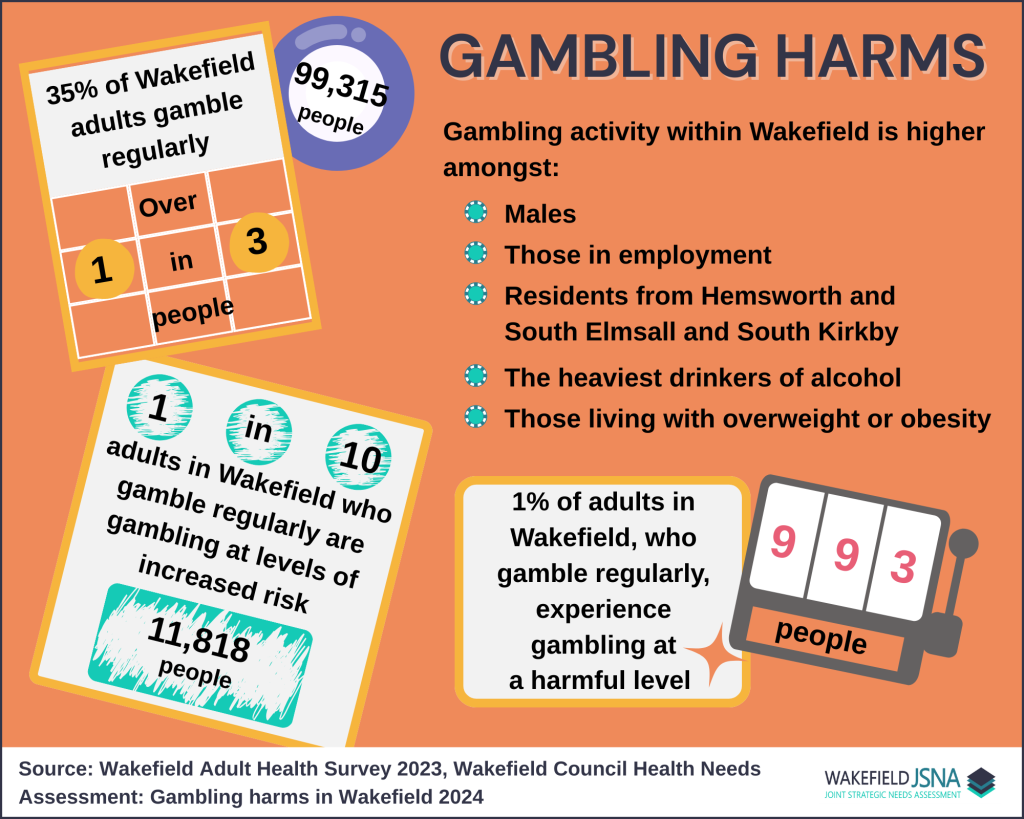
- Over a third (35%) of Wakefield adults gamble regularly (approximately 99,315 people).
- Gambling activity within Wakefield is higher amongst:
- Males (39%) (compared to females at 32%)
- Residents from Hemsworth (44%) and South Elmsall and South Kirkby (47%)
- Those in employment (38%) (compared to those not working at 32%)
- The heaviest drinkers of alcohol have the highest rates of gambling participation at 56% (compared to non-drinkers at 28%)
- Those living with overweight or obesity (39% and 40% respectively) (compared to those within a healthy BMI range at 27%)
- 1% of adults in Wakefield who gamble regularly (approximately 993 individuals) experience gambling at a harmful level and 11% of adults in Wakefield who gamble regularly (approximately 11,818 individuals) are gambling at levels of increased risk.
The HNA also finds that:
- The locations of gambling venues are disproportionately situated in deprived areas
How does Wakefield compare…
According to the Health Survey for England, 20214, 50% of adults nationally and 53% of adults across Yorkshire and Humber region had participated in a gambling activity in the last 12 months. Of the adults who had participated in gambling nationally, 3% were identified as engaging in at-risk gambling and 0.3% as engaging in gambling at a harmful level.
If such prevalence estimates are applied to the Wakefield population, 149,964 Wakefield residents would be projected to have participated in gambling in the last 12 months, with 7,923 residents engaging in at-risk gambling and 849 residents engaging in gambling at a harmful level.
Other national key findings from the HSE include:
- Men (55%) were more likely than women (45%) to take part in any gambling activity. With 4% of men compared to 1% of women engaging in at-risk gambling.
- 10% of adults had participated in any online gambling (excluding National Lottery and other lotteries) in the last 12 months.
- The proportion of adults who had participated in any type of gambling activity in the last 12 months was similar across area deprivation levels.
What are the differences within Wakefield district?
The Wakefield Adult Population Health Survey (APHS), 20233, analyses gambling activity across the Wakefield district, however the framing of the questions are different to those used in the HSE, so cannot be compared directly. The survey found:
- 35% of adults in Wakefield had gambled monthly over the last 12 months. The rate among men (39%) was significantly higher compared to women (32%).
- Gambling activity was higher among men compared to women across all age groups. For both men and women, gambling activity was highest within the 35 – 64 age bracket.
- Gambling activity was similar across deprivation quintiles. It should be noted that this does not mean that gambling has the same impact on different socioeconomic groups. Even with similar participation rates, some people, for example those living in more deprived areas, may be more vulnerable to gambling harms.
- Across all Wakefield wards, residents from Hemsworth (44%) and South Elmsall and South Kirkby (47%) were significantly more likely to have gambled at least once a month over the last 12 months.
- Residents from Horbury and South Ossett (26%) and Wakefield South (26%) reported the lowest rates.
- Those working full time (30+ hours per week) had a gambling activity rate of 41% and those in any employment of 38% (compared to those not working at 32%).
- The heaviest drinkers of alcohol have the highest rates of gambling participation at 56% compared to non-drinkers (27%).
- Respondents living with overweight or obesity were more likely to have gambled (39% and 40% respectively) whilst those within a healthy BMI range were less likely to have gambled (27%).
- Of those adults in Wakefield who gamble 6% were estimated to experience low risk, 5% a moderate risk, and 1% were categorised as participating in gambling at a harmful level. Based on these figures from the AHS, an estimated 11,818 adults in Wakefield are gambling at levels of increased risk, with 993 of those adults gambling at a harmful level.
- In line with national evidence, the higher the deprivation quintile, the lower the proportion of people are gambling at levels of no risk. 20% of people who gamble that are living in the most deprived quintile are gambling at a level of increased risk (low risk, moderate risk, or gambling at a harmful level), compared to 5% among those in the least deprived quintile.
- Although those aged 35 to 64 are the most likely age-group to gamble regularly, those aged 18 to 34 are more likely to exhibit risky gambling behaviours. 10% of gamblers in this age group are low risk gamblers, and 9% are moderate risk gamblers, in both cases significantly higher than those aged 35 to 64. Whilst not a significant variation, the proportion gambling at harmful levels is higher among 18 to 34 year olds (2%) than other age ranges.
The HNA also finds that:
- The locations of gambling venues are disproportionately situated in deprived areas, potentially exacerbating existing health inequalities and providing additional gambling opportunity to those most vulnerable.
What support is available?
- Home – NHS Northern Gambling Service – The Service provides specialist therapy and recovery programmes to people affected by gambling addiction, as well as help for those close to people with gambling addiction, such as family, partners, and carers.
- Gamblers Anonymous – England, Wales & Ulster – Gamblers Anonymous is a peer-to-peer support group where those affected by gambling can share experiences and provide each other with help and support.
Further information/Resources
- Protecting the public from being harmed or exploited by gambling and the gambling industry | ADPH – The Association of Directors of Public Health (ADPH) have published a series of recommendations to protect the public from being harmed or exploited by gambling and the gambling industry.
- Good governance toolkit | ADPH – A toolkit, endorsed by the ADPH providing a set of materials focused on improving governance of commercial interactions, relationships and influence in UK local authorities, to maximise benefits and minimise risk for population health.
- High stakes: gambling reform for the digital age – GOV.UK – A white paper which outlines the government’s proposed changes to the Gambling Act
- Y&H ADPH Gambling-Related Harm Funded Programme 2021-24 – A 3-year programme to prevent and reduce gambling-related harms.
- YHPHnetwork | Community of Improvement | Gambling Harms – Yorkshire and Humber Gambling harms Community of Improvement (CoI) meets quarterly with the aim to prevent and reduce gambling harms across the region. Representatives from each of the 15 local authorities in the region are invited and 14 of these have membership with regular attendance. Wakefield Council has regular attendance and contribution from its Public Health team.
- Home – NHS Northern Gambling Service – A service that takes a public health approach to reducing gambling harm, using research & clinical evidence in advocating for the prevention and reduction of population level gambling harm. The service specialises in delivering support and treatment for gambling-related harms as well as other co-occurring needs.