
Published: February 2026
A household can broadly be defined as experiencing food insecurity if they cannot (or are not sure whether they can) get an adequate quality or sufficient quantity of food in socially acceptable ways. The Food Standards Agency define food security as ‘having access at all times to enough food that is both sufficiently varied and culturally appropriate to sustain an active and healthy life’. Food insecurity is a major challenge nationally and is becoming more of a challenge with the rising cost of living.
According to the Department for Work and Pensions’ (DWP) Households Below Average Income survey, 7.2 million people (11%) in the UK were in food insecure households in 2023-24.
Food may be seen as something that can be cut back on by people and families who are struggling with household expenses and the cost of living. Other household costs, such as mortgage or rent payments, and fuel bills, may be seen as ‘more essential’. It’s also possible that situations differ even within a household. Parents may be experiencing food insecurity by missing meals to ensure their children can eat regularly, showing the complex nature of the issue.
Headlines
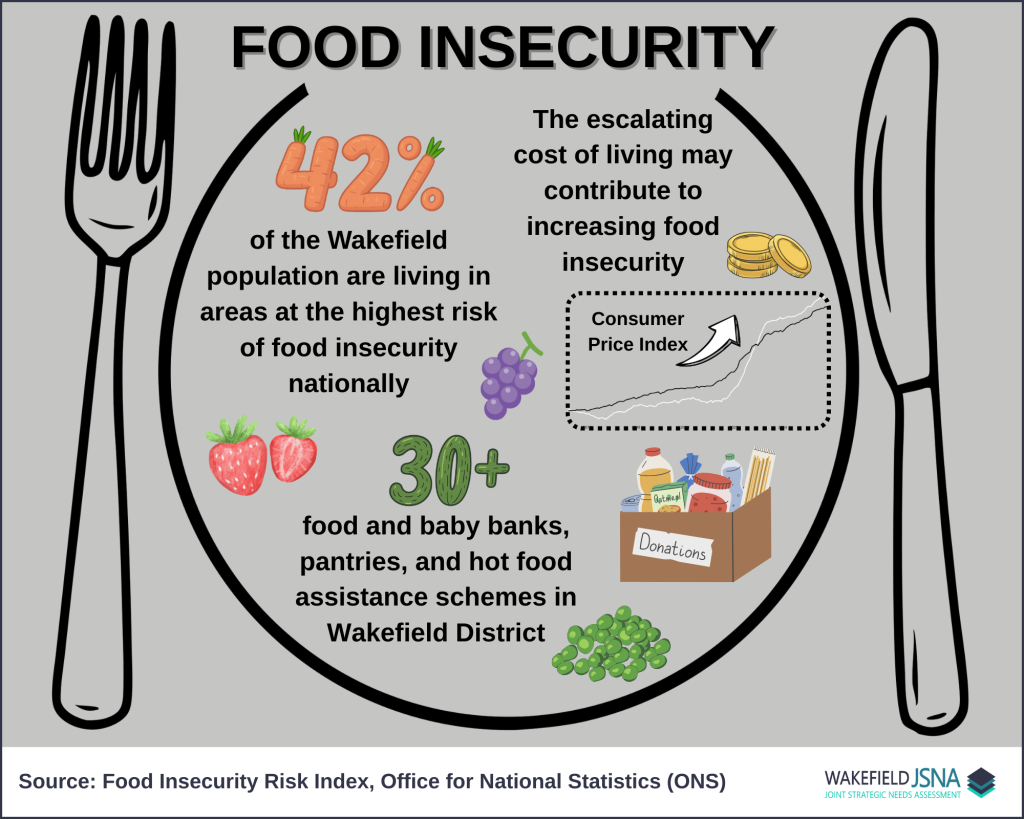
- The Food Insecurity Risk Index shows that 42% of the Wakefield population were living in the top 20% of areas at the highest risk of food insecurity in 2023-24.
- Around 37% of the Yorkshire and Humber region are food insecurity ‘priority places’, according to The Priority Places for Food Index. Priority places tend to have higher socio-economic barriers, higher need for food support, and higher fuel poverty.
- While cost of living is increasing across the country, average household income has remained relatively stable, meaning households have less disposable income which can impact on food security.
- Food security also includes having access to both a sufficently varied and culturally appropriate diet to sustain an active and healthy life. The Wakefield Adult Population Health Survey 2023 asked adults about their attitudes towards diet and healthy eating:
- Of those who said they wanted to eat more healthily, females, younger adults, and those in the more deprived areas of the district were more likely to say that cheaper fruit and vegetable prices would help with that.
- Of those who said they wanted to eat more healthily, one in four adults aged 18-34 and one in five adults aged 35-64 said that more time to prepare fruit and vegetables would help with that.
- There are a number of food and baby banks, food pantries, and hot food assistance schemes that operate across Wakefield District, providing food and other items to people and families who need it.
- Climate change may pose a significant threat to food security by potentially disrupting food production and distribution, increasing prices, and disproportionately affecting vulnerable populations.
Cost of living and the national context
- The Consumer Prices Index, including Owner Occupiers Housing Costs (CPIH) tracks the rate at which the prices of goods and services bought by households rise or fall over time in the UK. The overall index includes twelve index divisions, including food and non-alcoholic beverages, clothing and footwear, housing and household services, and transport.
- The overall CPIH increased steeply during 2021 and 2022, and continued to increase up to the end of 2025. The food and non-alcoholic beverage index saw an even steeper increase during same period.
- While CPIH has increased, average household income (median equivalised household disposable income) in the UK has remained relatively stable for the last decade, standing at £36,663 for 2023-24.
- Wakefield District is one of the most deprived 20% local authorities in England, ranking 59th out of 296 local authorities (where 1st is the most deprived).
The interactive dashboard below can be used to explore the national context in relation to the rising cost of living. Click on the buttons at the bottom to navigate between the different pages and use the date range on the left of each page to explore different time periods.
What are the differences within Wakefield District?
Two separate indices were developed to try to assess food insecurity in the UK and at a local level. The Food Insecurity Risk Index was developed by researchers at the University of Southampton and the National Institute for Health and Social Care Applied Research Collaboration (NIHR ARC) Wessex. The Priority Places for Food Index was developed by the Consumer Data Research Centre (CDRC) in collaboration with Which?.
Use the dropdown menus below to explore further information on the indices, including local level Wakefield data, as well as findings from the Wakefield Adult Population Health Survey 2023.
Food Insecurity Risk Index
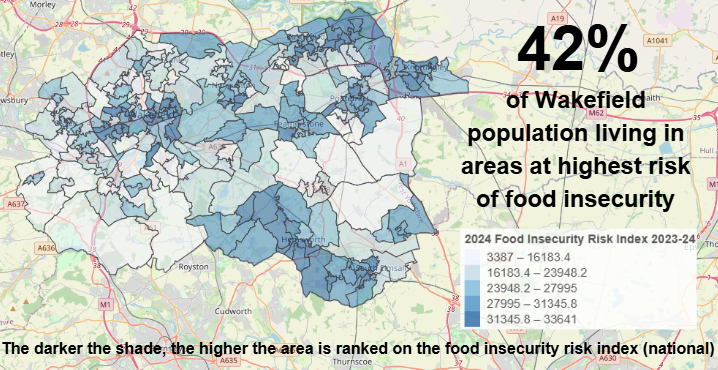
The graphic above shows the percentage of the Wakefield local authority population deemed to be living in areas at highest risk of food insecurity.
Small areas (LSOAs) are ranked in the index at a national level with 42% of the Wakefield population living in the top two deciles (20%) of areas at the highest risk nationally.
The map shows those most at risk based on the compositional rank index, which includes household structure, benefit claimants, poor mental health, and adult educational attainment. The darker sections of the map (those ranked at a higher risk of food insecurity) align closely with the most deprived areas of the district, including Wakefield centre, Castleford, Knottingley, Hemsworth and South Kirkby. There are also structural and economic elements which can influence food insecurity, particularly in more rural areas, including infrastructure, distances to employment and food stores, and internet speeds, as well as external factors such as pandemic measures.
Further information on the index can be found here: Household food insecurity risk indices for English neighbourhoods
The Priority Places for Food Index is a composite index formed of data compiled across seven different dimensions relating to food insecurity in the UK. The overall index combines dimensions, weighting them slightly differently, and covers: Using the index, it is calculated that 37% of the Yorkshire and Humber region are food insecurity ‘priority places’, second only to the North East (45%). The priority places tend to have higher socio-economic barriers, higher need for family food, higher fuel poverty, and are particularly concentrated in the West and South of Yorkshire. The interactive dashboard below can be used to explore the indices across Wakefield District. The overall index shows a similar picture to the Food Insecurity Risk Index in the previous section, with the darker sections of the map (in the higher priority deciles and at most risk of food insecurity) aligning closely with the most deprived areas of the district. The individual socio-economic barriers and fuel poverty indices also show the same areas being affected. Use the category selection to the left of the page to see how the overall index and individual dimensions vary across the district. Use the mouse scroll whilst hovering over the map to zoom in and out.
Further information on the index can be found here: Priority Places for Food Index – Consumer Data Research Centre
Priority Places for Food Index
As well as having access to enough food, food security includes having access to both a sufficently varied and culturally appropriate diet to sustain an active and healthy life. The Wakefield Adult Population Health Survey 2023 asked adults in the district about their attitudes towards diet and healthy eating. The interactive dashboard below can be used to explore the inequalities and differences across the district. Use the measure selection at the top of the page to explore the different options and the buttons on the left to explore the view by different demographics.
Further information on the Wakefield Adult Population Health Survey 2023 can be found here: Adult Population Health Survey – Wakefield JSNA
Attitudes towards Diet and Healthy Eating in Wakefield
Food banks, food pantries, and hot food assistance in Wakefield
- Food banks are generally run by charities and intended as a temporary provision to supply emergency food and other items free-of-charge to individuals and families who need it. There are around 20 food banks in Wakefield that span the district. Food pantries are seen as the next step to food banks. They are membership schemes where individuals and families sign up and often pay a fee or subscription to access food and other household essentials at a significant discount. Eight food pantries operate in the district. Food banks and pantries provided around 48,000 food parcels to individuals and families in Wakefield in 2024-25.
- There are also hot food assistance schemes in Wakefield, providing hot meals to those who need it. As well as street and community kitchen initiatives, some food banks in the district also provide hot meals. Just under 47,000 hot meals were served in Wakefield in 2024-25.
- Baby banks provide used baby and children clothing, equipment, toys, and other items, including food and drinks. There are four baby banks in the district.
Food bank and pantry usage cannot be used as a proxy for food insecurity. It is likely that fewer people use food banks than are vulnerable to food insecurity. The location of food banks is often based on community resources and local social networks.
Wakefield District Good Food Partnership
Wakefield District Good Food Partnership works to transform Wakefield District into a place where the food system does as much good as possible, and as little harm as possible. It strives to create a sustainable and equitable local food system for all.
The Partnership’s core values include ensuring everyone has access to healthier, good quality, safe and affordable food; fostering a vibrant, thriving, and diverse food economy; and promoting a food system that doesn’t harm biodiversity and the wider environment. Further information on the Partnership and it’s work can be found here: Wakefield District Good Food Partnership.
Further information
- Inflation and price indices – Office for National Statistics – includes Comsumer Prices Index, including Owner Occupiers Housing Costs (CPIH).
- Households below average income (HBAI) statistics – statistics on the number and percentage of people living in low-income households in the UK.
- Family Resources Survey – an annual report that provides facts and figures about the incomes and living circumstances of households and families in the UK.
- UK Food Security Index 2024 – an index that gives an assessment of the state of UK food security 2023 to 2024, using the latest available evidence.
- Household food insecurity risk indices for English neighbourhoods: Measures to support local policy decisions – Food Insecurity Risk Indices that aim to identify risk at a local level using geographical area alongside characteristics of the population.
- Priority Places for Food Index – Consumer Data Research Centre – a composite index formed of data compiled across seven different dimensions relating to food insecurity in the UK.
- Family Food FYE 2024 – GOV.UK – a report on the financial year ending 2024 Family Food Module of the Living Costs and Food Survey (LCFS).
- The Broken Plate 2025 | Food Foundation – a report looking at the trends impacting the UK’s food system and the actions needed to ensure everyone can afford healthy and sustainable food.
What support is available?
- Help with food – Wakefield Council – help and support for people struggling to provide food for them
selves or their family. Request assistance online. - Cost of living support – Wakefield Council – cost of living support from Wakefield Council, the Government and partners, including community-based support, Household Support Fund, and health support.
- Welcome to Cash Wise – Cash Wise – a service available to Vico Homes tenants and families with children under 12 offering free support and advice to help with financial issues.
- Free school meals – Wakefield Council – overview of the Free School Meals scheme and how to claim.
- West Yorkshire Food Poverty Network – Feeding Britain – food aid networks and support.
- Community based support – Help at the Hub – offers support with the cost of living in your local community. Help at the Hub centres offer help with money, debt, energy bills, housing, jobs and skills, and more.
- Wakefield Families Together – supporting families with resources, service, as well as advice and information for parents to help at Family and Youth Hubs.
- NHS Healthy Start – get help to buy food and milk if you’re more than 10 weeks pregnant or have a child under 4.